
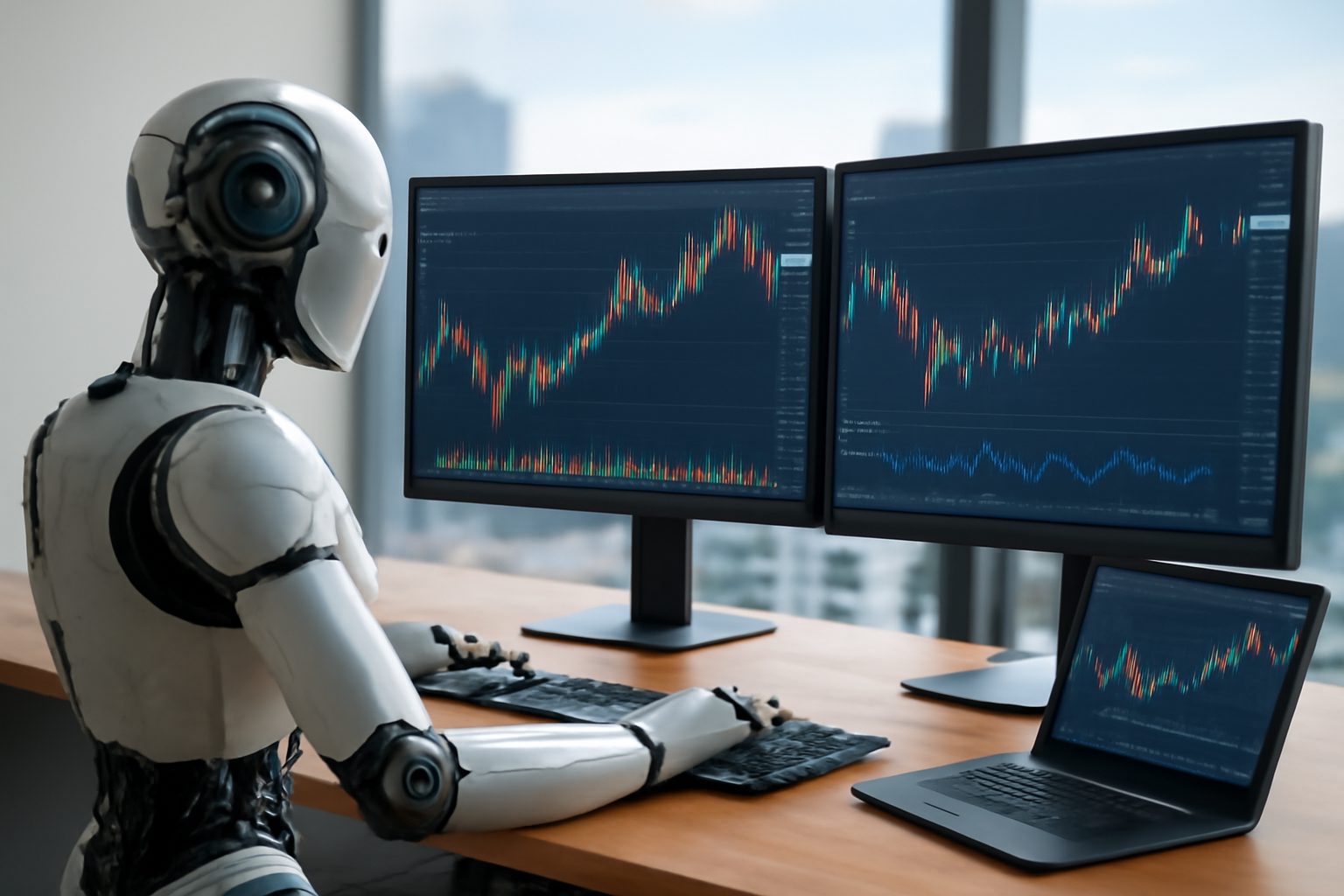
The world of automated trading is changing. The year 2026 marks a tipping point where cryptocurrency markets, having become ever more complex and unpredictable, make automation no longer an option, but a necessity. The real question is no longer whether to automate your operations, but rather how to identify the ideal solution that will translate and execute your strategies with impeccable accuracy and reliability. Between diversified tools like Coinrule and the flexibility of TradingView scripts, today's investors are faced with a crucial choice. How do you link a trading idea refined on an analysis tool to its automatic execution on an exchange? This article explores current trends and points you in the direction of the platform that will transform your alerts into actual trades, without unnecessary effort. To discover the simplicity of automated execution, you can start automating your online strategies from now on.
The automation imperative: from concept to immediate action
Historically, automated trading was the preserve of large financial institutions. Today, although it is accessible to all, the path from idea to transaction is often fragmented. It's common for traders to spend long hours fine-tuning a technical approach on TradingView, relying on indicators such as Bollinger Bands or bespoke scripts, only to come up against the difficulty of implementing it automatically. The real breakthrough of 2026 lies not so much in the robot's intrinsic capabilities, but in the fluidity of the value chain: analysis → signal → execution.
Market research shows a clear distinction between two approaches. On the one hand, "all-in-one" platforms that offer preconceived strategies, with subscription costs that can reach significant amounts. On the other, a more open ecosystem that favors expertise and personalization by the trader. As recent analyses show, the future belongs to solutions capable of bridging the gap between the analysis environment favored by traders and the reality of exchanges, whether centralized (CEX) or decentralized (DEX).
TradingView at the heart of strategic design
TradingView has established itself as the essential reference for technical analysis and social sharing in trading. Its vast library of scripts, where users share concepts under the generic term "robot", is a valuable resource for strategy development. It is essential, however, as TradingView itself reminds us, not to blindly rely on a script without fully understanding its internal logic. The challenge is therefore twofold: to develop or unearth a robust strategy on TradingView, and then to put it into practice beyond the simple chart.
It's at this crucial stage that many projects run into obstacles. Classic TradingView webhook alerts require a technical infrastructure (server, code) to be connected to an exchange, creating a technical barrier between the theoretical trader and the automated trader. The dominant trend in 2026 is to eliminate this friction, by offering direct and complete automation. The trader retains full control of his strategy, without having to manage the underlying technical aspects. To transform your Pine scripts into actual orders, automate your trading processes today.
The pillars of a high-performance automation platform in 2026
Faced with a multitude of alternatives, from community-shared "TopBot Anomaly Robot Strategy" scripts to complex SaaS solutions, here are the fundamental criteria to consider this year.
1. Consistency with your analysis environment
A platform that simply integrates rudimentary signals does not meet today's requirements. The ideal solution must master TradingView's Pine Script language and be able to faithfully translate the complex intent of an alert - including symbol, activation price, and even dynamic parameters - into a precise order on the exchange. Automation must be an exact reproduction of your trading plan, not an approximate interpretation. This is the key to exploiting the full potential of trading robots.
2. Extended market connectivity: CEX and DEX
Research data highlights a growing interest in trading on decentralized platforms (DEX). A platform of the future must therefore be compatible with the main CEXs (for their liquidity) and DEXs (for autonomous custody of funds and access to new assets). The ability to manage fees, slippage and different order types (market, limit, stop-loss) on these varied infrastructures is an indicator of quality. An efficient trading robot adapts to the ecosystem you've chosen.
3. Transparency and risk management
Solutions based on "black box" strategies are becoming less and less popular. The trader of 2026 demands to understand, audit and optimize. Access to detailed performance history is essential. The ability to backtest logic (even if the initial development takes place on TradingView) is crucial. Integrated risk management tools (such as position size and global stop-loss) are a must. As Tickerly's guide points out, accuracy and reliability of execution are what distinguish successful bots. Expertise is built on transparency.
4. A fair, scalable business model
Subscription models costing several hundred dollars a month are only justified if they deliver proportional value, often linked to trading volume. For active traders developing their own strategies, a transparent, scalable pricing model with no surprises is preferable. The added value lies in reliable execution, not in a catalog of predefined strategies you may never use. The legitimacy of a platform is measured by the fairness of its business model.
FAQ : Your most important questions about trading robots in 2026
Can a trading robot guarantee regular profits?
A robot is just an execution tool. It doesn't magically generate profits; it consistently executes the strategy you've given it. Its value lies in the discipline, speed and lack of emotion it brings. Success therefore depends 90% on the robustness of your TradingView strategy and risk management, and 10% on the reliability of the bot's execution. Without a solid strategy, a trading bot will only accelerate losses.
Should I choose a platform with preconceived strategies or one that executes my own strategies?
The choice depends on your profile. Predefined strategies (such as those mentioned in some comparisons) are perfect for novices who want to learn about automation without mastering technical analysis. However, for an experienced trader who has developed an edge in the markets, a platform that executes its own strategies is far more powerful. It allows you to precisely replicate your manual trading process, continually optimize it and retain total control over the operational logic. This is the road to professional automation with trading robots.
Is automation compatible with decentralized exchanges (DEX)?
Absolutely, and it's even a major trend in 2026. While early bots were primarily designed for CEXs, more and more solutions allow interaction with DEXs. This offers the possibility of automating strategies on new tokens while retaining custody of your funds. The technical complexity is higher (gas fee management, transaction signatures), hence the interest in using a specialized platform that simplifies these challenges for you. You can test the automation of your orders on your favorite platforms from now on.
How do you assess the security of a trading robot platform?
Security is a non-negotiable criterion. Opt for platforms that use API keys with limited authorizations (only for trading, never for withdrawals). Make sure they offer end-to-end encryption for your sensitive information. Look for independent security audits and a policy of incident transparency. A trustworthy platform will never require your private keys to interact with a DEX. The sovereignty and security of your funds must be the top priority of any automation service.
The future of automated trading: sovereignty and community
The underlying trend goes far beyond simple order execution. We're moving towards an ecosystem where the trader is the real architect. He builds his strategy in the environment of his choice (TradingView) and deploys it via a reliable platform that manages tedious technical connections. He retains total control over risk parameters and funds, whether on a CEX or a portfolio connected to a DEX.
This "sovereign" approach differs from "all-in-one" robots like AutoTrade Crypto, which focus on a specific market (e.g. Bitcoin, Ethereum) with an internal logic. The future lies in interoperability and customization. Your expertise, combined with a tool that faithfully executes your instructions, represents the most powerful synergy.
The importance of community and sharing, visible through TradingView's "robot" page and the sharing of scripts such as the "TopBot Anomaly", is undeniable. Automation platforms that incorporate a social dimension enrich the ecosystem by enabling the sharing of automation configurations, not just signals. Learning risk parameters or connection methods from other traders becomes a major competitive advantage. The reliability of trading robots is also validated by collective experience.
In conclusion, choosing a trading bot platform in 2026 is no longer just a matter of comparing features. It's about finding the solution that naturally integrates with your analysis process, respects your strategic autonomy and executes your trades with surgical precision across the entire crypto ecosystem. The objective is clear: entrust technical execution to the machine, so you can concentrate on what's essential - analyzing the markets and sharpening your edge. Intelligent robot trading automation is no longer a distant prospect, but an unavoidable standard for any serious trader. To take this decisive step, deploy your TradingView strategies for free today.

 English
  French
  Spanish